Medicare stair lift: not covered by Original Medicare
Original Medicare does not pay for a stair lift or for grab bars. Federal rules treat stairway elevators as convenience equipment and safety grab bars as self-help devices, so neither one is durable medical equipment [1][2]. CMS states that home modifications are not covered, and a ramp or a widened doorway is a change to the house rather than medical equipment [1][3]. A patient lift used to move someone from a bed is a different item, and Medicare lists that kind of lift among equipment it can cover [4].
What has to be true before Medicare will buy equipment
Original Medicare pays for durable medical equipment only when the item meets the definition, is necessary and reasonable for treatment of an illness or injury or to improve the functioning of a malformed body part, and is used in the patient's home [1]. A doctor's note can speak to medical need. It cannot, by itself, turn a convenience item into medical equipment.
Every part of the definition has to be met. The item must withstand repeated use, meaning it is the kind of thing that could normally be rented. It must be primarily and customarily used for a medical purpose. It must generally not be useful to someone who is not ill or injured. And it must be appropriate for use in the home [1].
The manual then names items that are presumed nonmedical. Equipment that basically serves comfort or convenience, or that is mainly for the convenience of a person caring for the patient, is not medical equipment. Elevators and stairway elevators are the examples CMS gives. The next sentence places safety grab bars with other self-help devices and calls them nonmedical [1]. That section was revised in 2021, and it is still the rule in force. The national Durable Medical Equipment Reference List, in the version effective June 9, 2025, denies the same items by name [2].
Stair lifts
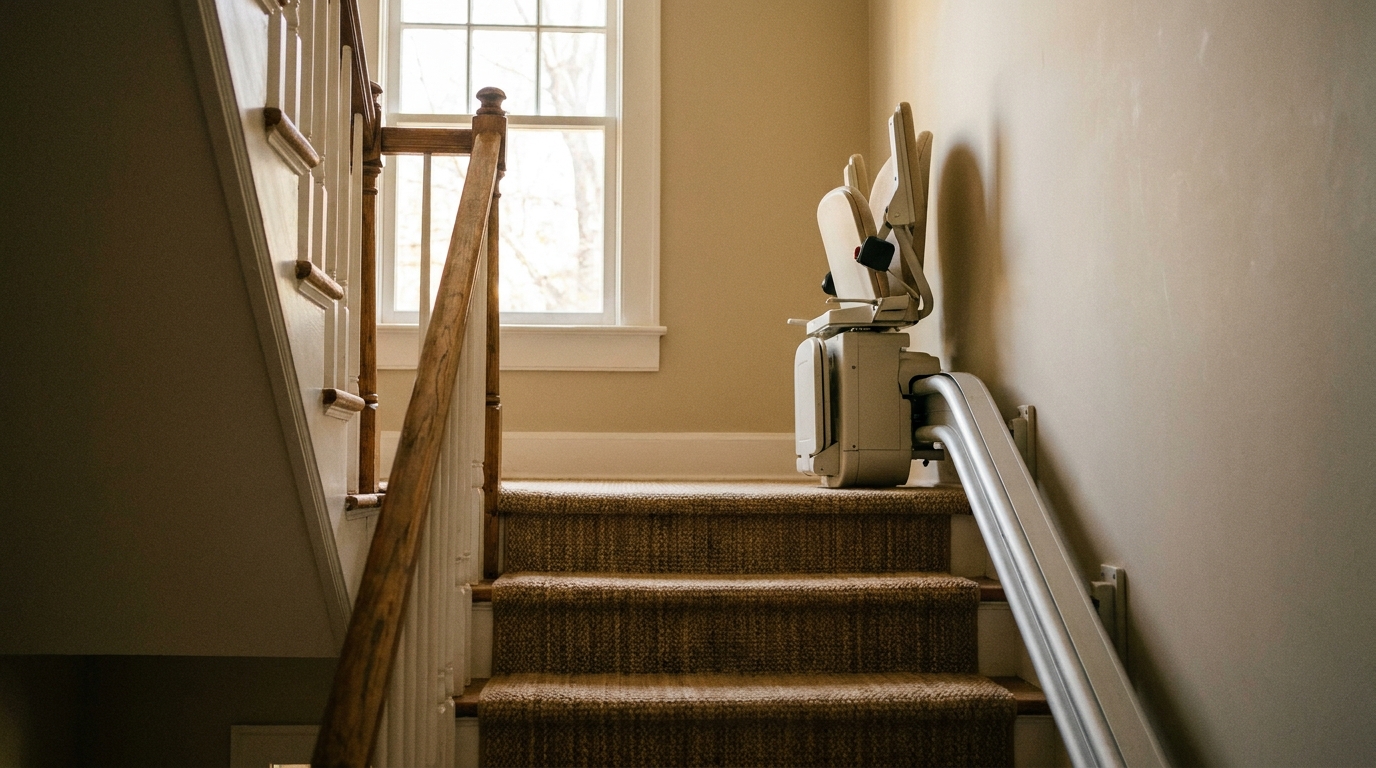
A stair lift, the chair that runs on a rail beside the steps, is what Medicare calls a stairway elevator. On the national reference list, stairway elevators are marked "Deny," with a pointer to the entry for elevators. Elevators are denied as a convenience item, not primarily medical in nature [2]. The coverage manual says the same thing in ordinary language: stairway elevators do not constitute medical equipment [1].
Families sometimes hear that a doctor's order will make Medicare pay. Under the manual, payment starts with the definition. A stairway elevator fails that definition before anyone debates medical necessity, and using it at home does not move it into a covered category [1]. Hardship does not change the test. A person may be unable to live on one floor without the rail. CMS still treats the stair lift as a convenience feature, not as medical equipment [1][2].
If a quote for a stair chair says "patient lift," ask for a plainer description. Those names are not interchangeable, and mixing them up is how a family expects a payment Medicare will not make.
Grab bars and other bathroom hardware
Grab bars are denied on the same national list. CMS marks them "Deny" as a self-help device, not primarily medical in nature [2]. The manual uses the phrase "safety grab bars" and groups them with nonmedical self-help devices [1].
Other bathroom items people often buy on the same errand are denied by name as well.
Bathtub lifts are denied as a convenience item, not primarily medical in nature [2]. Bathtub seats are denied as a comfort or convenience item and as hygienic equipment, not primarily medical [2]. Raised toilet seats are denied on those same comfort and hygiene grounds [2]. Toilet seats are denied because they are not medical equipment [2].
A bar or a bath seat can still be worth buying with household money or local help. Medicare's denial means the program will not reimburse it, not that the product is useless.
One bathroom item sits in a different column. A commode chair can be covered if the person is confined to a bed or to a room [2]. That is equipment for someone who cannot get to a toilet. It is not a rail beside the tub. If a clinician means a commode, ask them to say so.
Ramps and widened doorways
CMS's patient-lift policy article states the rule in a short sentence: home modifications are not covered by Medicare. The next sentence tells suppliers not to submit claims for structural changes or remodeling required to install a lift system [3]. The article does not print the words "wheelchair ramp" or "widened door." What it does say is that home modifications, and the structural work that goes with installing a lift, sit outside Medicare payment.
An entrance ramp that is built onto the house is a modification of the house. So is a doorway that a carpenter opens wider so a wheelchair can pass. Neither one is equipment a supplier rents to one patient and then to the next, which is the durability idea in the coverage manual [1]. Original Medicare does not buy that construction.
Read that article in its context. It is written for patient-lift claims, and the billing line after the home-modification sentence is about structural changes needed to install a lift. The national list does not have a separate "ramp" entry the way it has entries for stairway elevators and grab bars [2][3]. Plan on the home-modification sentence anyway. Do not expect a Medicare check for the ramp or the new door opening, and do not accept a promise that a special billing code will make a carpenter's invoice payable unless someone can show you that rule in writing.
A patient lift is not a stair lift
Medicare's booklet on durable medical equipment includes, among examples it can cover, patient lifts to lift you from a bed or wheelchair [4]. The booklet is the February 2025 edition, and the list is not a promise that every device with "lift" in the name qualifies. It is a sign that this kind of lift sits in a covered category, unlike a stairway elevator.
The conditions are in CMS instructions for suppliers. The page was last modified on February 11, 2026. Medicare covers a patient lift for transfers between a bed and a chair, a wheelchair, or a commode, if the person would be confined to a bed without it [5]. That is a transfer at the bedside. It is not a ride between floors, and it is not a chair fixed to the staircase.
A lift made for the toilet or the tub is not covered. The policy article says that kind of device is not primarily medical in nature [3]. If the quote is for a bath lift, you are back with the bathtub lifts the national list denies [2].
For equipment Medicare does cover, the February 2025 booklet states the usual share of the cost. After the Part B deductible for the year, you generally pay 20 percent of the Medicare-approved amount, and Medicare pays only if the supplier is enrolled [4]. That 20 percent figure does not apply to a stair lift, a grab bar, or a ramp, because there is no Medicare-approved amount for those items. Home modifications also stay not covered, including structural changes or remodeling so a lift system will fit [3]. A supplier who is not enrolled does not create coverage by handing you a receipt [4].
If a clinician believes a bed-transfer lift is the right device, the next call is to a Medicare-enrolled supplier, not to a company that installs stair chairs.
Medicare Advantage plans and Medigap policies
A Medicare Advantage plan must cover the same medically necessary categories of durable medical equipment as Original Medicare [4]. That duty does not add stair lifts, grab bars, or home construction. Some plans offer extras beyond those categories. The document that describes extras, and what you pay for Medicare-covered services, is the plan's Evidence of Coverage [4].
In an analysis published June 5, 2026, using CMS enrollment and benefit files, KFF found that 21 percent of people in individual Medicare Advantage plans were in a plan offering bathroom safety devices, down from 32 percent in 2025 [6]. Enrollees in Special Needs Plans were more likely to have that extra available: 60 percent, compared with 21 percent in other Medicare Advantage plans [6]. KFF reports that it is not yet known what share of enrollees used these benefits, and that the count does not account for changes in eligibility, cost sharing, or how generous a benefit is [6].
Bathroom safety devices are not a stair lift, and they are not a permanent ramp. A plan that lists the extra may cap it, require an assessment, or limit which products count. If you have Medicare Advantage, ask the plan to point to the Evidence of Coverage and say whether bathroom safety items are included this year. A "no" is allowed. The plan is not withholding a standard Medicare benefit.
Medigap, the supplement people buy with Original Medicare, helps cover your share of the cost for services Original Medicare already covers, including copayments, coinsurance, and deductibles [7]. Some policies also cover emergency care outside the United States [7]. The equipment booklet says a Medigap policy may help with costs of covered durable medical equipment [4]. It does not say a supplement pays for a stair lift, a grab bar, or a ramp. If Original Medicare does not approve the item, there is no coinsurance for Medigap to pay, and a different Medigap letter does not change that.
North Carolina help that is not a Medicare check
North Carolina describes a home-improvement service for some people 60 and older, and it is separate from Medicare. On the Department of Health and Human Services page for Housing and Home Improvement Assistance, the service is minor repairs for owner-occupied and renter-occupied homes. A renter needs written permission from the landlord. There are four categories: security enhancements, minor home repairs, mobility and accessibility improvements, and basic household furnishings or appliance repair, replacement, or purchase. A local agency may choose which categories it provides [8].
To qualify, a person must be 60 or older, have no one able and willing to perform the services, and live in a county where the service is funded under the Home and Community Care Block Grant [8]. Funding is not guaranteed in every county. For a family in Greensboro or elsewhere in the Piedmont, the useful question is local. Ask the provider whether the service is funded in that county this program year, and whether mobility and accessibility work is a category that provider offers.
The state limits this help to no more than $7,000 per individual per program year [8]. That number is a program cap, not the price of a stair lift, and it is not a payment you receive simply by calling. The same page says the money cannot pay rent, utility bills, food, medicine, deposits, or taxes, and it cannot pay for work that harms the structure of the home, work a landlord already owes, or a repeat of the same improvement for three years [8]. A large stair project may not fit what the state calls minor repair. Ask what the local provider can take on. Do not treat the program as a promise to install a stair lift.
When the question is what Medicare or a private plan covers, North Carolina's Seniors' Health Insurance Information Program, called SHIIP, offers free counseling. Counselors are in every county, local counseling is by appointment, and the toll-free line is 1-855-408-1212, Monday through Friday from 8 a.m. to 5 p.m. SHIIP counselors are not licensed insurance agents, and they do not sell or endorse any product, plan, or company. If the question is about your specific plan, SHIIP says to contact your agent or the insurance company [9]. That line can help you understand a coverage rule. It does not hire a contractor, and it does not take the place of reading the Evidence of Coverage.
Before anyone signs a contract
Name the object before you talk about payment. A stair chair, a wall bar, a door ramp, a wider doorway, and a lift that picks someone up off a bed are different things. Only the last one is a candidate for Original Medicare, and only when the person would be confined to a bed without it [2][5].
If the need is a bed transfer, confirm that rule with the treating clinician and use a Medicare-enrolled supplier before anything is delivered [4][5]. If the need is the stairs, the wall, or the entrance, plan without Original Medicare unless a Medicare Advantage Evidence of Coverage actually lists an extra [4][6]. At age 60 or older, ask the local Housing and Home Improvement provider whether accessibility work is funded in that county, and keep the $7,000 cap in view [8]. Ask the contractor to separate permanent construction from equipment that could be removed. In Greensboro and across the Piedmont, our work is that coverage reading. We do not build ramps, and we cannot make Original Medicare pay for a rail on the stairs.
Practical takeaways
- Original Medicare does not cover stairway elevators or safety grab bars. The coverage manual and the national equipment list both say so [1][2].
- Bathtub lifts, bathtub seats, raised toilet seats, and toilet seats are denied by name on that national list [2].
- Home modifications are not covered, including structural changes tied to installing a lift. A built ramp or a widened doorway is a change to the house, not rented medical equipment [1][3].
- A patient lift can be covered for transfers between a bed and a chair, wheelchair, or commode if the person would be bed-confined without it. A toilet or tub lift is not covered [3][5].
- For covered equipment, you generally pay 20 percent of the Medicare-approved amount after the Part B deductible, and the supplier must be enrolled in Medicare [4].
- Medicare Advantage plans must cover the same equipment categories as Original Medicare. Bathroom safety extras are plan-specific. In 2026, 21 percent of individual-plan enrollees were in a plan offering bathroom safety devices, down from 32 percent in 2025 [4][6].
- Medigap helps pay your share of services Original Medicare covers. It does not add a stair lift the program excludes [4][7].
- North Carolina's Housing and Home Improvement service may help some people 60 and older with mobility and accessibility work, only in funded counties, and only up to $7,000 per individual per program year [8].
How we can help
Have more questions or want to get in touch? Our team at Seniors Insurance Hub helps families in Greensboro and the Piedmont sort Medicare coverage questions, including what Original Medicare will not buy for the house. Call (336) 937-7501 or use our contact page.
Citations
- Centers for Medicare & Medicaid Services, "Medicare Benefit Policy Manual, Chapter 15, Sections 110 and 110.1" (2021-08-06)
- Centers for Medicare & Medicaid Services, "NCD 280.1, Durable Medical Equipment Reference List" (2025-06-09)
- Centers for Medicare & Medicaid Services, "Patient Lifts - Policy Article (A52516)" (2020-01-01)
- Medicare.gov, "Medicare Coverage of Durable Medical Equipment & Other Devices" (2025-02)
- Centers for Medicare & Medicaid Services, "Patient Lifts" (2026-02-11)
- KFF, "Medicare Advantage in 2026: Premiums, Out-of-Pocket Limits, Supplemental Benefits, and Prior Authorization" (2026-06-05)
- Medicare.gov, "Learn what Medigap Covers" (2026)
- North Carolina Department of Health and Human Services, "Housing and Home Improvement Assistance" (2026)
- North Carolina Department of Insurance, "Contact Seniors' Health Insurance Information Program (SHIIP)" (2026)