Medicare cancer treatment coverage: chemo and radiation
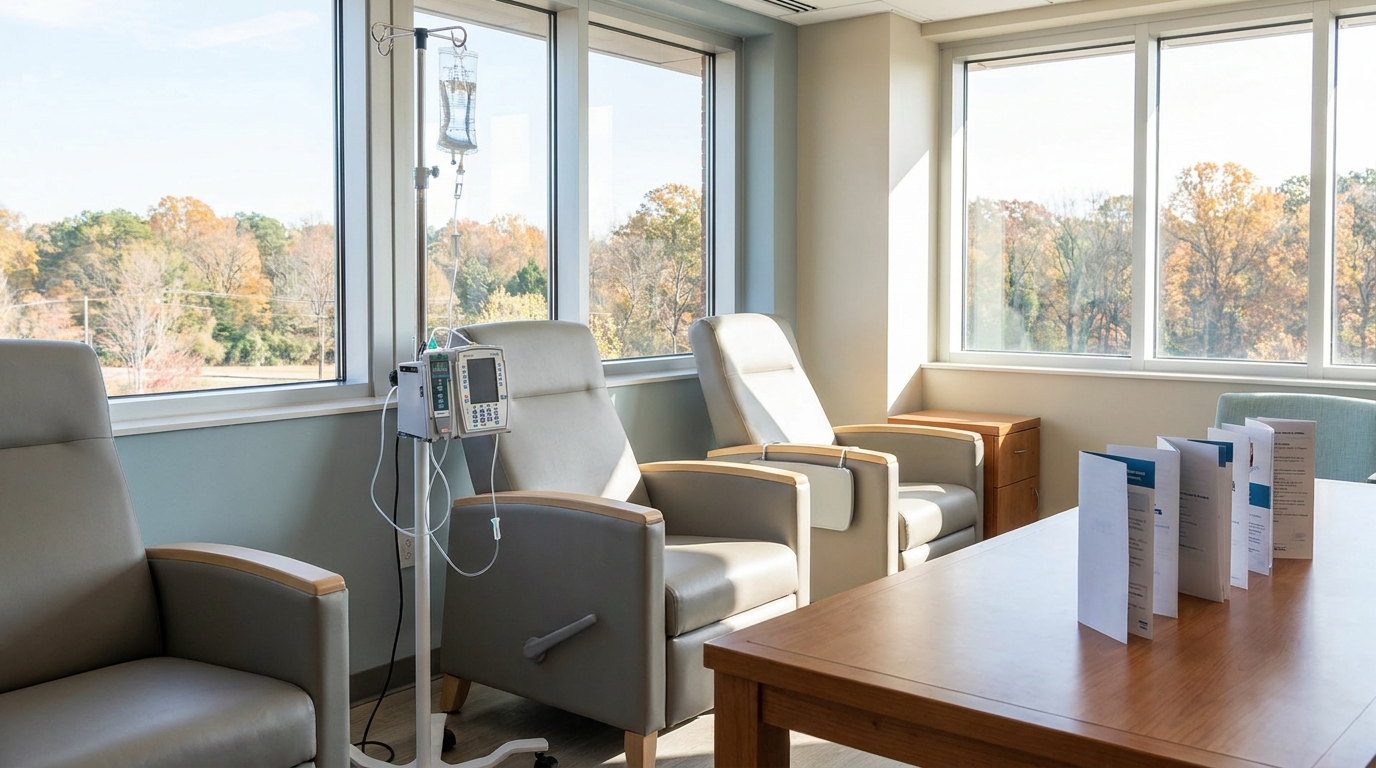
When cancer treatment is about to start, the useful question is which part of Medicare pays, and what share is left. Medicare cancer treatment coverage under Original Medicare follows the setting of the care. Medicare covers chemotherapy if you have cancer, with Part A when you are a hospital inpatient and Part B when you are a hospital outpatient or you get the drugs in a doctor's office or a freestanding clinic [1]. Medicare also covers radiation therapy, with Part A for hospital inpatients and Part B for outpatients or for patients in freestanding clinics [2]. Those pages do not list a separate North Carolina rate. A clinic in Greensboro and a hospital elsewhere in the Piedmont follow the same inpatient and outpatient split.
The setting decides the part that pays
You are an inpatient starting when you are formally admitted with a doctor's order, and the day before discharge is your last inpatient day [6]. You are an outpatient if you are getting emergency care, observation services, outpatient surgery, lab tests, X-rays, or other hospital services without an admission order, even if you spend the night [6]. Observation is outpatient care while the doctor decides whether to admit you or send you home [6]. An inpatient admission is generally appropriate when you are expected to need 2 or more midnights of medically necessary hospital care, but the doctor must order it and the hospital must formally admit you [6].
Ask each day whether the status is inpatient or outpatient [6]. Part A covers inpatient hospital stays, including cancer treatments you get while you are an inpatient, and you can still be an outpatient in a hospital bed [9]. Status changes what you pay for hospital services such as drugs and lab tests, and it can affect a later skilled nursing facility stay [6]. If observation lasts more than 24 hours, the hospital must give you a Medicare Outpatient Observation Notice explaining that outpatient status [6]. In a Medicare Advantage Plan, costs may differ, so check with the plan [6].
Inpatient hospital treatment
Part A usually covers the stay when a doctor admits you with an order saying you need inpatient care to treat your illness or injury, and the hospital accepts Medicare [5]. Covered services can include a semi-private room, meals, general nursing, certain drugs, and other hospital services and supplies that are part of the inpatient treatment [5]. Medicare does not cover private-duty nursing, a private room unless it is medically necessary, a television or phone billed separately, or personal items such as razors or slipper socks [5].
Inpatient chemotherapy is a Part A benefit [1]. Inpatient radiation is a Part A benefit as well, and the radiation page says an inpatient pays the Part A deductible and coinsurance if they apply [2]. That page does not print its own dollar schedule. In 2026 the Part A deductible is $1,736 for each inpatient hospital benefit period, before Original Medicare starts to pay [3][4]. You pay that deductible each time a new benefit period starts, and because there is no limit on how many benefit periods you can have in a year, you may pay it more than once in a year [4]. A benefit period begins the day you are admitted as an inpatient in a hospital or skilled nursing facility, and it ends when you have gone 60 days in a row without inpatient hospital care or skilled care in a skilled nursing facility [4]. After that break, a new admission starts a new benefit period and the deductible is due again [4].
In a 2026 benefit period you pay $0 each day for days 1 through 60 after the Part A deductible, $434 each day for days 61 through 90, and $868 each day for days 91 through 150 while using lifetime reserve days, and you pay all costs after day 150 [3][5]. You have 60 lifetime reserve days, and they can be used once in your lifetime [5]. If you are in a Medicare Advantage Plan, you may owe copayments during the first 60 days, which is not Original Medicare's $0 daily amount after the deductible [5].
Doctor bills are separate. Part B generally covers 80% of the Medicare-approved amount for doctors' services while you are a hospital inpatient [5]. Your share on Medicare's cost chart is 20% of the Medicare-approved amount for most of those doctor services [4]. The Part B deductible also applies, and in 2026 it is $283, paid once each year [3].
Outpatient chemotherapy
Part B covers chemotherapy if you are a hospital outpatient or you get it in a doctor's office or a freestanding clinic [1]. Medicare calls chemotherapy a drug treatment that kills fast-growing cells, including cancer cells, and the cancer booklet describes many of those drugs as given through a vein in an outpatient clinic or a doctor's office [1][9]. After the Part B deductible, you typically pay 20% of the Medicare-approved amount for chemotherapy in a doctor's office, a freestanding clinic, or a hospital outpatient setting [1]. In 2026 that deductible is $283, once a year [3]. If chemotherapy is given in a hospital outpatient setting, the copayment will not be more than the inpatient deductible [1]. In 2026 that deductible is $1,736 [3]. The chemotherapy page does not say a long series of visits, added together, stops at that amount.
Hospital outpatient billing, as a general rule, has two pieces. You usually pay 20% of the Medicare-approved amount for the doctor's services, and that care can cost more in a hospital outpatient department than in an independent office [7]. You also usually pay the hospital a copayment for each service, and in most cases that copayment cannot be more than the Part A deductible for the service [7]. At a critical access hospital, the copayment may be higher and may exceed the Part A deductible [7]. That exception is on the outpatient hospital page, not on the chemotherapy or radiation pages. Separately, the copayment for a single outpatient hospital service cannot be more than the inpatient deductible, while the total of all outpatient copayments can be higher [6]. Other insurance, the doctor's charge, assignment, the facility, and the location can all change what you owe [1]. Assignment means the provider is paid by Medicare, accepts the approved amount, and does not bill you beyond the deductible and coinsurance [9].
Outpatient radiation
Part A covers radiation for hospital inpatients, and Part B covers it for outpatients and for patients in freestanding clinics [2]. An inpatient pays the Part A deductible and coinsurance if they apply [2]. An outpatient, or someone treated in a freestanding clinic, pays 20% of the Medicare-approved amount for the therapy after the Part B deductible [2]. The radiation page does not limit a hospital outpatient copayment to the inpatient deductible. That sentence is about chemotherapy, and it lives on the chemotherapy page [1]. If a hospital bills radiation as an outpatient hospital service, the facility copayment comes from the outpatient hospital rule: a copayment for each service, usually along with 20% for the provider, and in most cases that copayment cannot exceed the Part A deductible for the service [7]. A freestanding clinic is not that hospital setting. Its price on the radiation page is the 20% coinsurance after the Part B deductible [2].
Other insurance, charges, assignment, facility type, and location can change the radiation bill too [2]. Ask who will send the claim, and whether that provider accepts assignment, before the first visit. Each outpatient or freestanding treatment is subject to that 20% after the deductible, and Original Medicare has no yearly out-of-pocket limit unless you have supplemental coverage such as Medigap or you join a Medicare Advantage Plan [2][3].
Oral cancer drugs, only where Medicare draws the line
Part B does not treat every cancer pill like an infusion. It covers some cancer drugs you take by mouth if the same drug is available in injectable form, or if the pill is a prodrug of that injectable drug [8]. Medicare describes a prodrug as an oral form that breaks down into the same active ingredient after you take it [8]. Part B also covers oral anti-nausea drugs used before, during, or within 48 hours of chemotherapy, or used as a full replacement for an intravenous anti-nausea drug [8].
In most cases, after the Part B deductible, you pay up to 20% of the Medicare-approved amount for Part B drugs, and that coinsurance can change with the drug's price [8]. It may be lower for certain Part B drugs and biologicals whose prices rose faster than inflation, and the drugs and the savings change every quarter [8]. Providers and pharmacies must accept assignment for these drugs and should not charge more than the coinsurance or copayment for the drug itself [8]. A drug given in a hospital outpatient setting that Part B does not cover is your cost unless other drug coverage pays [8].
Part D is a separate choice. You have it only if you join a Medicare drug plan or a Medicare Advantage Plan with drug coverage [9]. Part D covers many drugs Part B does not, and if Part B does not cover a cancer drug, the plan may cover it if the drug is on the formulary at a stated tier [8][9][12]. The cancer booklet says Part D may cover chemotherapy drugs only when they are taken by mouth, plus anti-nausea drugs and other prescriptions used in treatment, such as pain medication [9]. Plans must include most drugs in protected classes, including cancer drugs, but a specific product can still be left off the list, and in most cases a similar drug should be available [12]. Drugs given during a covered inpatient stay are generally Part A, not a Part D pharmacy claim [12]. If you are new to a plan and your drug is off the formulary, the plan must allow a temporary supply of 30 days, or 91 days if you live in a long-term care facility [9].
What else can change the bill
Original Medicare has no yearly limit on out-of-pocket costs unless you have supplemental coverage, such as Medigap, or you join a Medicare Advantage Plan [3]. A Medigap policy or a group health plan may pay some of the costs for the cancer services and supplies described in Medicare's booklet [9]. Medigap is private insurance that helps pay copayments, coinsurance, and deductibles under Original Medicare, and you can buy it only if you have Original Medicare [10].
Medigap open enrollment is a one-time period of 6 months that starts the first month you have Part B and you are 65 or older, and during that window a company cannot deny you coverage for a pre-existing condition [10]. After it ends, a policy may be unavailable or cost more, and the window does not come back every year [10]. The cancer booklet says people may want to review coverage after a diagnosis, and that coverage can be changed only at certain times [9]. Nothing on these pages starts a new Medigap open enrollment because of cancer.
In most states, same-letter policies share the same basic benefits, and price is what differs between companies [10]. Medicare lists Massachusetts, Minnesota, and Wisconsin as the states with a different Medigap standard [10]. North Carolina is not on that list. A policy you already hold renews each year even if your health changes, as long as the premium is paid, and the company can drop it for unpaid premiums, an untruthful application, or the company going out of business [11]. Medicare pays its share of the approved amount, Medigap pays what the policy covers, and you owe anything left, with the amount depending on the policy [4][11]. We describe that side of the work on our Medicare supplement page. One letter is not the right policy for every household.
Medigap policies sold after 2005 do not include prescription drug coverage, so a first-time buyer needs a separate Part D plan for drugs [11]. Medigap also cannot pay Medicare Advantage copayments, deductibles, or premiums, and you cannot have both at the same time [11]. An Advantage plan must cover at least what Original Medicare covers, but its costs can differ, and once you reach the plan's yearly limit it pays 100% of covered health services for the rest of the year [3][9]. Ask whether the oncologist and the facility accept the plan before treatment starts [9]. Do not assume the outpatient 20% on the chemotherapy or radiation pages is the Advantage plan's charge [1][2].
Questions to ask before the first treatment
Ask whether this stay is inpatient or outpatient, and ask again if it continues [6]. Ask whether the chemotherapy or radiation will be Part A or Part B, and whether the hospital will send a separate outpatient facility claim [1][2][7]. If the drug is a pill, ask whether it meets the Part B oral-cancer test or belongs on a Part D formulary [8][9]. If another policy or an Advantage plan is in the picture, ask that plan what it pays at that provider [9]. For a named service, Medicare's booklet points people to Medicare.gov or 1-800-MEDICARE at 1-800-633-4227, and TTY users can call 1-877-486-2048 [9].
Practical takeaways
- Formal admission, not an overnight stay, is what makes hospital care inpatient [6].
- Inpatient chemotherapy and inpatient radiation are Part A benefits [1][2]. In 2026 the Part A deductible is $1,736 per benefit period, and a new benefit period can mean paying it again [3][4].
- Outpatient chemotherapy in an office, freestanding clinic, or hospital outpatient setting is Part B, and after the deductible you typically pay 20% of the Medicare-approved amount [1]. The 2026 Part B deductible is $283, once a year [3].
- A hospital outpatient chemotherapy copayment will not be more than the inpatient deductible, but copayments for every outpatient service can still total more [1][6]. A critical access hospital may charge an outpatient copayment above the Part A deductible [7].
- Outpatient or freestanding radiation is 20% of the Medicare-approved amount after the Part B deductible [2]. The chemotherapy copayment limit is not a radiation rule [1].
- Part B covers only some oral cancer drugs, under the injectable-form or prodrug test, and Part D is optional coverage you join for many other prescriptions [8][9].
- Original Medicare has no yearly out-of-pocket limit unless you have Medigap or you join Medicare Advantage, and Medigap sold after 2005 does not include Part D drugs [3][11].
How we can help
Have more questions or want to get in touch? Call our team at (336) 937-7501, or write to us on our contact page. We talk with seniors, and with adult children who help their parents, in Greensboro and across the Piedmont. Bring the treatment plan, or just the question of whether care will be inpatient, outpatient, or a prescription. We will help you line that up with Original Medicare, a supplement, or a Medicare Advantage Plan, and with the share that can remain.
Citations
- Medicare.gov, "Chemotherapy" (2026-10-21)
- Medicare.gov, "Radiation therapy" (2026-10-21)
- Medicare.gov, "What does Medicare cost?" (2026-10-21)
- Medicare.gov, "Costs" (2026-10-21)
- Medicare.gov, "Inpatient hospital care" (2026-10-21)
- Medicare.gov, "Inpatient or outpatient hospital status affects your costs" (2026-10-21)
- Medicare.gov, "Outpatient hospital services" (2026-10-21)
- Medicare.gov, "Prescription drugs (outpatient)" (2026-10-21)
- Medicare.gov, "Medicare Coverage of Cancer Treatment Services" (2025-09)
- Medicare.gov, "Get Medigap Basics" (2026-10-21)
- Medicare.gov, "Learn How Medigap Works" (2026-10-21)
- Medicare.gov, "How do drug plans work?" (2026-10-21)